
Lycian Fauna: Wildlife from the Mountains to the Sea
Lycian Fauna spans a wide range of habitats, from the steep summits of the Western Taurus to the depths of the Mediterranean. The region lies on the bird migration routes between Europe, Africa and the Middle East, and its rocky mountains are home to species found nowhere else in the world. For thousands of years this wildlife has also featured in the region’s art, mythology and daily life.
In this guide you will meet the creatures of the Land of Light in five layers: mammals, birds, marine life, reptiles and amphibians, and arthropods.
📌 Contents
Lycian Fauna Ecology: Life from the Mountains to the Sea
Lycian Fauna is closely tied to the region’s vegetation zones, which run from the sea to the summits. From the coastal maquis to the red pine and cedar forests, and up to the rocky peaks above 3,000 metres, each zone supports its own community of animals. The healthier the vegetation, the richer the wildlife. For these zones, see our Lycian Flora page.
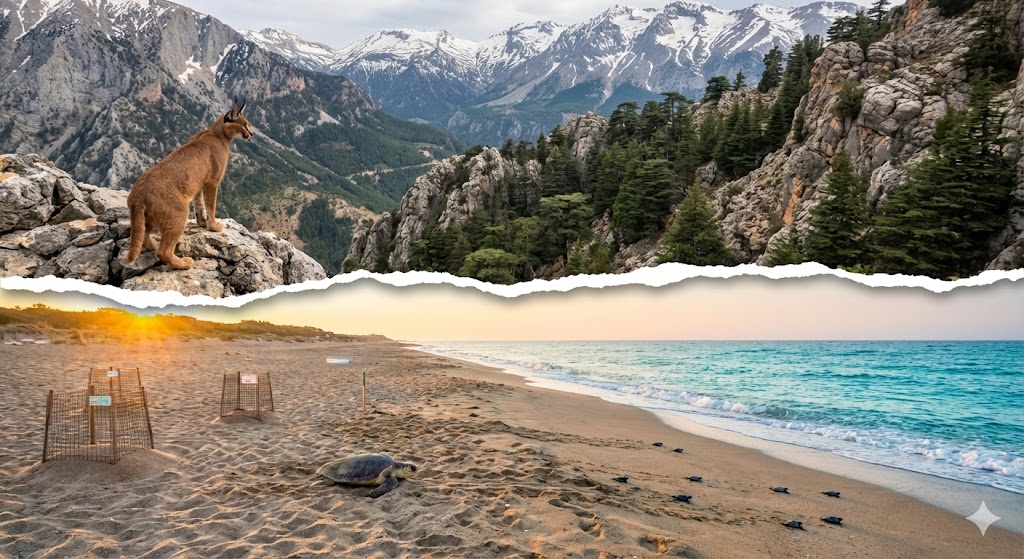
Layer 1: Lycian Mammals
The region’s rugged, forested terrain has allowed many mammals to survive to the present day.
- Wild goat (Capra aegagrus): A symbol of the Lycian mountains, living on the steep, rocky slopes of the Bey Mountains and Akdağ.
- Caracal (Caracal caracal): The region’s most elusive mammal. Very shy and largely nocturnal, it is rarely seen but has been recorded by camera traps.
- Other species: Wild boar, foxes, golden jackals, badgers and stone martens are common in the region.
For the habitats and tracks of these animals, see our Lycian Mammals page.
Layer 2: Inhabitants of the Sky: Lycian Birds
Lying on bird migration routes, Lycia is a rewarding region for birdwatchers.
- Birds of prey: Golden eagles, short-toed eagles and peregrine falcons can be seen soaring over the high mountains.
- Wetland birds: The dunes and marshes of Patara and Beymelek Lagoon near Demre are important stopovers for migratory birds. Kingfishers, herons and ducks can be seen here.
- Migration: Many species pass through the region in spring and autumn.
For the migration calendar and observation points, see our Lycian Birds page.
Layer 3: Marine Life
Lycian Fauna is as rich in the waters off the Lycian coast as it is on land.
- Sea turtles: Patara and Çıralı are among the important nesting beaches of Caretta caretta in the Mediterranean. Green turtles also come to these shores to feed.
- Mediterranean monk seal (Monachus monachus): This endangered mammal uses the secluded sea caves of Kaş and Kekova as shelters.
- Dolphins: Species such as the common bottlenose dolphin can be seen offshore.
- Fish: Groupers, amberjack, barracuda and moray eels are well-known inhabitants of the rocky reefs.
- Invasive species: The lionfish, the silver-cheeked toadfish (deniz tavşanı) and the blue crab, which entered the Mediterranean through the Suez Canal, are spreading along this coast too. The toadfish is highly poisonous and must never be eaten.
For marine species, see our Lycian Marine Life page, and for the underwater world, our Diving in Lycia page.
Layer 4: Reptiles and Amphibians
The region’s warm, dry climate offers good habitats for reptiles, while its damp limestone mountains are home to amphibians found nowhere else.
- Lycian salamanders (Lyciasalamandra): The species of this genus live almost exclusively in the limestone mountains of Lycia, each in a very small area. They can be seen among the rocks on damp winter days.
- Chameleons and lizards: The chameleon of the maquis zone is known for its camouflage.
- Tortoises and snakes: Spur-thighed tortoises are often seen in the maquis and fields. Most snakes are harmless, but vipers also live in the region.
For the region’s snakes and tortoises, see our Lycian Reptiles page.
Layer 5: Arthropods and Butterflies
Lycia is also rich in insects and butterflies. Many butterfly species, some found only in Anatolia, appear with the flowers in spring and summer. Butterfly Valley takes its name from the Jersey tiger moths that gather there in summer, and the valley is also home to many butterfly species.
For the region’s invertebrates, including insects, spiders, snails and marine invertebrates, see our Lycian Invertebrates page.
Protecting Wildlife
- Distance: Watch wildlife from a distance and do not approach.
- Do not feed: Feeding wild animals disrupts their natural behaviour and makes them dependent on people.
- Quiet: Loud noise causes great stress, especially during the nesting season.
- Turtles and seals: Stay off nesting beaches at night. If you see a seal, do not approach it or enter its caves.
- Do not collect: Never take salamanders, tortoises or any other animal from the wild.
For species unique to the region, see our Endemic and Rare Species of Lycia article, and for more tips, our Sustainable Travel and Ethics Guide.
❓ Frequently Asked Questions
Are there dangerous animals in Lycia?
Some vipers and scorpions live in the region, but they do not attack unless disturbed. Wearing closed shoes on walks and not putting your hands into rock crevices you cannot see are enough. In the sea, do not touch the poisonous silver-cheeked toadfish or lionfish.
Is it possible to see a caracal?
It is very difficult. Caracals are shy and largely nocturnal, and their presence in the region is known mainly from camera-trap records.
When is the best time to watch Lycian wildlife?
Spring and autumn for bird migration, spring and early summer for reptiles, the damp winter months for salamanders, and September–October, when the water is clearest, for marine life. For details, see our Lycian Nature Calendar page.