
Lycian Nature: The Land of Light from Sea to Summit
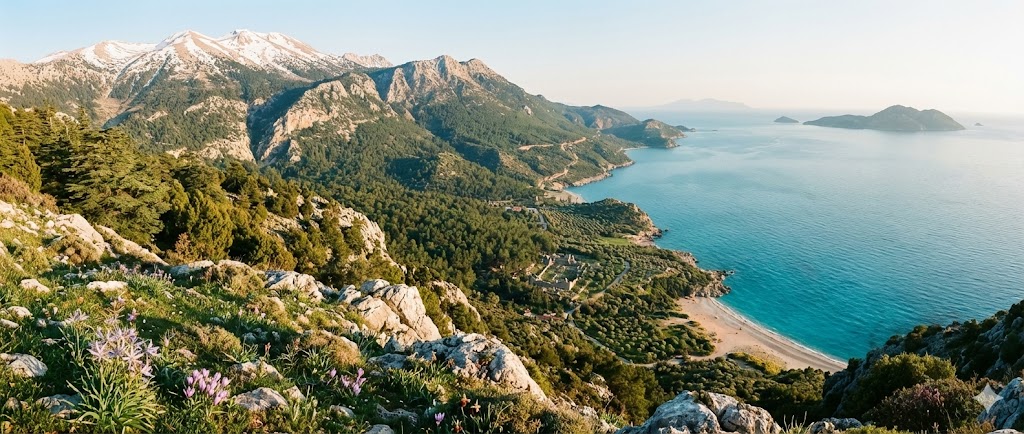
What makes Lycian Nature unique is that a few hours’ drive can take you from the sea to summits over three thousand metres high. Kızlarsivrisi, the highest point of the Bey Mountains, rises to about 3,070 metres, close to the sea as the crow flies. Within this short distance lie maquis-covered shores, red pine forests, cedar and juniper woods, high plateaus and rocky peaks. Each zone has its own plants and wildlife, and some species live nowhere else in the world.
On this page you will find Lycia’s geography, vegetation zones, wildlife, two species unique to the region, protected areas and ways to explore nature responsibly.
📌 Contents
Lycian Nature: Where the Taurus Meets the Sea
Lycia’s landscape is shaped by the Western Taurus Mountains. Most of the region is limestone, which water has dissolved and carved over millions of years into gorges, caves, sinkholes and underground springs.
- Mountains: The Bey Mountains and Akdağ are the region’s two great mountain masses. Snow can linger on their summits until late spring.
- Gorges and valleys: Saklıkent Gorge is a deep, cool cleft that feeds into the Eşen (Xanthos) River. Butterfly Valley opens to the sea between steep cliffs.
- Plateaus: High plains such as Elmalı and Seki have served as summer pastures and farmland for centuries.
- Underground water: Water flowing through the limestone emerges in some coves as cold freshwater springs that seep into the sea.
- Yanartaş (Chimaera): On a hillside near Olympos, natural gas seeping from the rocks has burned for thousands of years.
Vegetation Zones
The vegetation changes several times as you climb from the sea to the summits.
- Coast and maquis: Drought-tolerant, aromatic plants such as olive, carob, myrtle, bay, Greek strawberry tree and thyme.
- Red pine forests: The region’s most widespread forests, stretching from the coast to the foothills.
- Black pine, cedar and juniper: Higher up, cool, dry mountain forests begin. Çığlıkara in Elmalı is one of Türkiye’s most important cedar forests, with trees centuries old.
- High mountain zone: Above the tree line, many endemic plants found only in these mountains grow among the rocks.
For the region’s plants, endemic species and forest types, see our Lycian Flora page.
Wildlife
- Mammals: Wild goats, wild boar, foxes, badgers and martens are among the region’s mammals. The rarely seen caracal has also been recorded here.
- Birds: Birds of prey such as the golden eagle and griffon vulture soar over the mountains, while migratory birds pass through the wetlands in spring and autumn.
- Reptiles and amphibians: Caretta caretta turtles nest on beaches such as Patara and Çıralı, and salamander species found only in this region live in the mountains.
- The sea: The endangered Mediterranean monk seal is occasionally seen along the Kaş-Kekova coast.
For the region’s mammals, birds, reptiles and marine life, see our Lycian Fauna page.
Species Unique to Lycia
Lycia’s mountains and coasts are home to many species found nowhere else in the world. Here are a few of the best known.
- Lycian salamanders (Lyciasalamandra): The species of this genus live almost exclusively in the limestone mountains of Lycia. Separate species and subspecies, each with a very small range, occur between Dalaman and Fethiye, Kaş and Finike, and Kemer and Tekirova; some occupy no more than a few square kilometres. They give birth to live young instead of laying eggs, emerging in the damp winter months and spending the dry summer in rock crevices.
- The Kaş orchid (Ophrys lycia): A critically endangered ground orchid known only from the area around Kaş.
- Antalya’s other endemic orchids: Ophrys climacis and Ophrys phaseliana, named after Phaselis, are also known only from this region and are under threat.
- The Cretan date palm (Phoenix theophrasti): Türkiye’s only native palm. One of its few natural stands in the country is near Kumluca.
- The national park’s endemics: Olympos-Beydağları National Park is home to many plants that grow only in these mountains, such as Sideritis lycia (Lycian ironwort).
To protect these species, we do not share where they live. If you see a salamander or orchid in the wild, do not touch or pick it, and do not share its location on social media. Collecting orchids and endemic plants without permission carries heavy fines. For more on these species, see our Endemic and Rare Species of Lycia article.
Protected Areas
Much of Lycia’s natural landscape is protected:
- National parks: Olympos-Beydağları National Park and Saklıkent National Park.
- Specially Protected Areas: Fethiye-Göcek, Patara and Kaş-Kekova.
- Other areas: Ölüdeniz Nature Park and the Çığlıkara Nature Reserve in Elmalı.
Watching Nature: Season by Season
- Spring (March–May): The richest season, with plants in flower, orchids blooming and migratory birds passing through.
- Summer (June–August): The turtle nesting season on the coast, and the time to head to the highlands for cooler air.
- Autumn (September–November): The second wave of bird migration, crocuses, and nature reviving with the first rains.
- Winter (December–February): Snow in the mountains, and the season when salamanders emerge in damp valleys.
For details, see our Lycian Nature Calendar page, and for the best observation points, our Lycian Photography and Observation Routes page.
Photography and observation: Do not approach or disturb wildlife. Do not fly drones near nests or use recorded calls to attract birds. Never pick or move plants for a photograph.
Protecting Nature
- Fire: The risk of forest fires is very high. Never light fires in the forest or drop cigarette ends.
- Trails: Stay on marked paths.
- Plants and bulbs: Picking plants and digging up bulbs is prohibited in protected areas, and many species are protected by law.
- Waste: Take everything you bring to the mountains and coves back with you.
For more tips, see our Sustainable Travel and Ethics Guide.
❓ Frequently Asked Questions
When is the best time to see Lycian nature?
Spring (March–May) is the richest season for flowers, orchids and bird migration. Autumn (September–November) is also excellent for walking and wildlife watching.
Can I camp in protected areas?
In national parks and protected areas, camping is generally only allowed at designated sites. Check the rules for each area before you go. For places to stay, see our Lycian Accommodation Guide.
Are there dangerous animals in the region?
Wild boar, scorpions and some vipers live here, but they avoid people if you move quietly along the trail. In pine forests in late winter and spring, do not touch pine processionary caterpillars; their hairs irritate the skin and eyes.