Lycian City Names: The Local Names of the Land of Light
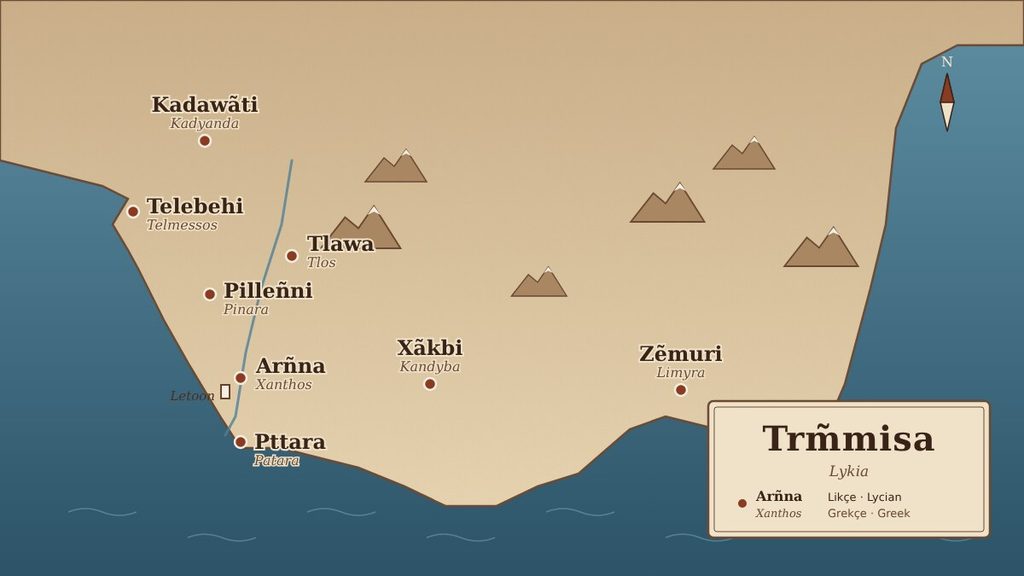
Most of the ancient city names we see on signposts today, such as Xanthos, Patara and Limyra, are Greek forms. The Lycians themselves called their cities by other names in their own language: Xanthos was Arñna, Tlos was Tlawa and Limyra was Zẽmuri. Some of these names can be traced in Hittite records back to the Bronze Age, which makes them important evidence for the continuity of these cities and their people on this land.
In this article we look at how Lycian city names are known, which ones are certain and which are only proposed, and how they changed from Hittite to Greek.
📌 Contents
- What Kind of Language Is Lycian?
- Three Names for One City: Hittite, Lycian, Greek
- How Do We Know the Lycian Names?
- The “-nda” and “-ssos” Endings
- Established Lycian City Names
- Proposed and Disputed Names
- What Does the Patara Road Monument Tell Us?
- Tracing the Names on Your Travels
- Frequently Asked Questions
- Sources
What Kind of Language Is Lycian?
Lycian belongs, with Hittite and Luwian, to the Anatolian language family. Within that family it sits in the same branch as Luwian and is very closely related to it. The Lycians called themselves the Trm̃mili and their land Trm̃misa.
Most Lycian inscriptions date from the 5th and 4th centuries BC. They are written in an alphabet adapted from Greek, with extra letters added for Lycian sounds. Signs such as ñ, m̃, ã and ẽ in the names mark nasal sounds.
Most known Lycian inscriptions are carved on rock-cut tombs. There are also inscribed stelae and coins. A second dialect, known as Lycian B (Milyan), was also used in the region.
Three Names for One City: Hittite, Lycian, Greek
The names of some Lycian cities can be traced across three periods. The monument of the Hittite king Tudhaliya IV at Yalburt, near Ilgın in Konya (13th century BC), describes a campaign into the Lukka lands. Its place names reappear centuries later in Lycian and Greek forms:
| In Hittite records | Lycian | Greek / today |
|---|---|---|
| Awarna | Arñna | Xanthos |
| Dalawa | Tlawa | Tlos |
| Pinali | Pilleñni | Pinara |
| Wiyanawanda | — | Oinoanda |
| Lukka | Trm̃mili (the people) | Lykioi (Lycians) |
This is some of the strongest evidence that the Lycians were not newcomers but an Anatolian people living here since the Bronze Age. For more, see our Lycian History and The Anatolian Roots of Lycia articles.
How Do We Know the Lycian Names?
Inscriptions. The key piece of evidence is the trilingual inscription found at the Letoon in 1973. Dated to the 4th century BC, it gives the same text in Lycian, Greek and Aramaic. Arñna in the Lycian text appears as Xanthos in the Greek, which proves the link between the two names. The inscription is now displayed in the Fethiye Museum.
Coins. Some of the silver coins struck by the local dynasts who ruled Lycia in the 5th and 4th centuries BC carry city names in Lycian. Zẽmuri for Limyra and Telebehi for Telmessos, for example, are known from coins.
Ancient authors. Greek and Roman writers sometimes record local names. Pliny writes that Antiphellos (Kaş) was formerly called Habesos, and Stephanus of Byzantium reports that the Lycians called round hills “pinara”.
The “-nda” and “-ssos” Endings
Many place names in and around Lycia end in “-nda” or “-ssos”: Kadyanda, Oinoanda, Arykanda, Isinda; Telmessos, Tymnessos, Termessos. These endings are not Greek. Linguists believe they come from adjective-forming suffixes in Luwian and related Anatolian languages.
The clearest example is Oinoanda. Its Hittite name, Wiyanawanda, combines Luwian wiyana- (“wine”) with the suffix “-wanda” (“rich in”), meaning “(the place) rich in wine”. The Greeks turned it into Oinoanda, a form that echoes their own word for wine, oinos.
Established Lycian City Names
The names below appear in Lycian inscriptions or on coins, and their Greek equivalents are securely known.
| Greek / modern name | Lycian name | Note |
|---|---|---|
| Xanthos | Arñna | Proven by the Letoon trilingual. Hittite Awarna. |
| Tlos | Tlawa | Hittite Dalawa. |
| Pinara | Pilleñni | Possibly Hittite Pinali. |
| Patara | Pttara | Attested in Lycian inscriptions. |
| Telmessos (Fethiye) | Telebehi | On inscriptions and coins. |
| Limyra | Zẽmuri | On coins and inscriptions. |
| Kandyba | Xãkbi | Attested in Lycian inscriptions. |
| Kadyanda | Kadawãti | Attested in Lycian inscriptions. |
In most cases the meaning of these names is unknown. The inscriptions tell us which city a name belongs to, not what it means.
Proposed and Disputed Names
The following identifications appear in the sources but are not certain.
Pinara and “round”: Stephanus of Byzantium reports that the Lycians called round hills “pinara”. The large, rounded rock mass above the city fits this explanation, but the meaning is not confirmed by Lycian inscriptions.
Antiphellos (Kaş) and Habesos: Pliny gives this as the former name of Antiphellos. It is not confirmed in Lycian inscriptions.
Phellos: It has been suggested that the city’s Lycian name was Wehñti. The Greek word phellos means “cork oak”.
Myra: The city’s Lycian name is disputed. None of the proposed forms is established.
What Does the Patara Road Monument Tell Us?
The Patara Road Monument (Stadiasmus Patarensis) was discovered at Patara in 1993. Lycia had become a Roman province in AD 43 under the Emperor Claudius, and the monument was set up in his honour shortly afterwards, in AD 45/46. Its Greek inscription lists the roads built in Lycia under Roman rule and the distances between cities.
The monument contains no Lycian names. However, with more than fifty place names and the distances between them, it is an invaluable source for locating ancient cities and understanding the historical geography of the region. Some sections of today’s Lycian Way follow this old road network.
Tracing the Names on Your Travels
- Letoon: The sanctuary where the trilingual inscription was found. You can see the inscription itself in the Fethiye Museum.
- Xanthos: The monument known as the Inscribed Pillar carries the longest known Lycian text.
- Pinara: As you look at the rounded rock mass above the city, you can think of the explanation Stephanus records.
- Rock-cut tombs: Many house-shaped tombs carry short Lycian inscriptions at their entrances. These usually name who built the tomb and for whom.
Please do not touch the inscriptions or rub chalk or water on them. See our Sustainable Travel and Ethics Guide for details.
❓Frequently Asked Questions (FAQ)
Can Lycian be read today?
Yes. The Lycian alphabet has been deciphered and the texts can be read. However, part of the vocabulary is still not fully understood, which is why the meaning of many city names is unknown.
Why is the Letoon trilingual inscription important?
Because it gives the same text in Lycian, Greek and Aramaic, it shows the Greek equivalents of Lycian words and names directly. The match Arñna = Xanthos was proven by this inscription.
Are Lycian and Luwian the same language?
No, but they are closely related. Both belong to the same branch of the Anatolian language family.
Why do signposts use Greek names?
The names by which ancient cities are known today come largely from Greek and Roman sources. The Lycian names have come to light only through the study of inscriptions.
Sources
- H. Craig Melchert, A Dictionary of the Lycian Language, Ann Arbor/New York 2004.
- Trevor R. Bryce, The Lycians in Literary and Epigraphic Sources, Copenhagen 1986.
- Antony G. Keen, Dynastic Lycia, Leiden 1998.
- Sencer Şahin – Mustafa Adak, Stadiasmus Patarensis: Itinera Romana Provinciae Lyciae, Istanbul 2007.
- eDiAna: Dictionary of the Minor Ancient Anatolian Corpus Languages (University of Munich)
- UNESCO World Heritage Centre, Xanthos-Letoon