

The Hidden Land of Light Beneath the Modern City
Situated at the border of Antalya and Muğla, right in the center of the Fethiye district, Telmessos Ancient City stands as the most important settlement on the western border of Lycia. Despite being partially covered by modern construction, Telmessos acts as a living museum, with Lycian sarcophagi emerging from almost every street and monumental rock-cut tombs climbing toward the sky. Having been continuously inhabited since the Bronze Age, the city is mentioned as “Kuvalapašša” in Hittite texts and “Telebehi” in native Lycian-inscribed tombs.
From Legends to Reality: The Foundation of Telmessos
During the period of Greek colonization, grand foundation myths were crafted for Telmessos. The most widespread of these suggests that the city was established by Minos, the exiled brother of the Cretan prince Sarpedon. However, archaeological data proves that long before these legends, the city was already an organic part of the indigenous Luwian/Lycian civilization of Anatolia.
The Famous Seers of Telmessos
In the ancient world, the first thing that came to mind regarding Telmessos was its absolute supremacy in the art of divination (mantike). The seers of Telmessos were so remarkably talented in interpreting dreams and foretelling the future that legendary rulers, ranging from King Croesus of Lydia to Alexander the Great, traveled here to consult them. In this respect, the city was widely recognized as the primary religious and spiritual advisory center of Lycia.
🏛️ The Architectural Legacy of Telmessos and Highlight Structures
Wandering through the modern streets of Fethiye, the ruins of Telmessos Ancient City whisper tales of the settlement’s past commercial and cultural prosperity:
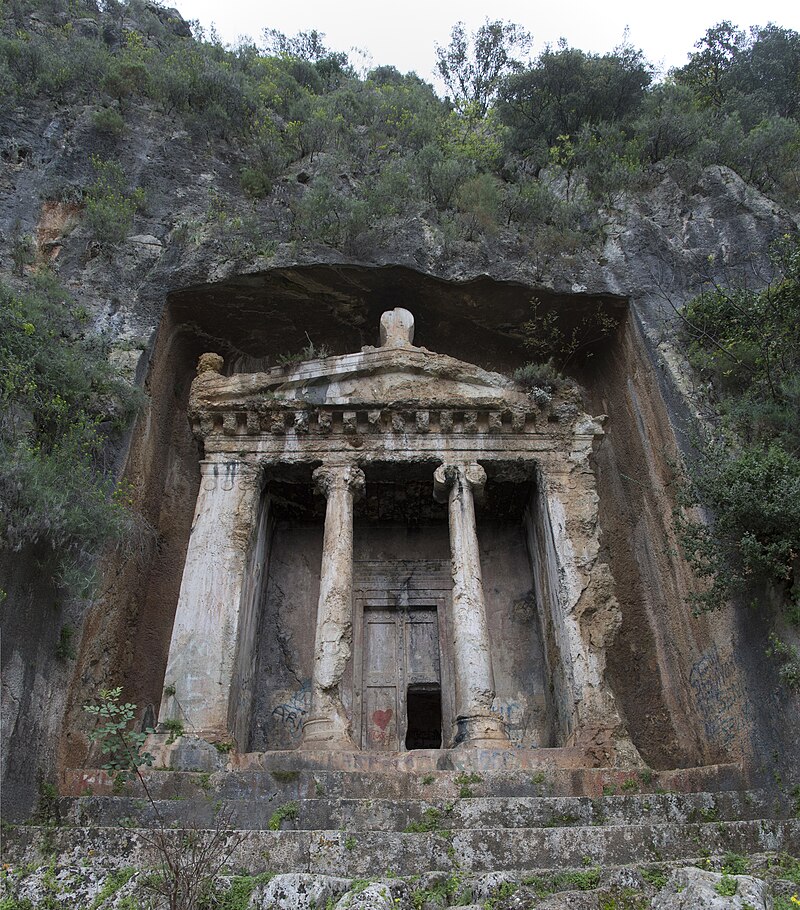
1. The Amyntas Rock Tomb: The Icon of the City
Dating back to the 4th century B.C. and belonging to Amyntas, son of Hermapias, this tomb is the ultimate symbol of the city. Adorned with two columns in the Ionic order and a monumental doorway, it strongly resembles a temple. Its position on a steep hill overlooking the settlement reflects the ancient belief that the city’s nobles continued to watch over their people even after death.
2. The Telmessos Ancient Theater
Located right behind the harbor, this theater was originally constructed during the Hellenistic period and subsequently renovated during the Roman era. With a capacity of approximately 5,000 spectators, Telmessos served as the artistic center of the region. Having remained buried under soil for a long period, the structure was brought back to light through systematic excavations and now hosts various modern cultural events.
3. Sarcophagi: Silent Witnessing in the Backstreets
While walking through central Fethiye, it is completely normal to encounter a Lycian-type sarcophagus sitting right in front of a shop or in the middle of a public park. These sarcophagi demonstrate just how extensive the necropolis area of Telmessos Ancient City was and how seamlessly the ancient layout is intertwined with modern life.
🏛️ Three Defining Features to Know About Telmessos
| Criterion | Detail |
| Political Status | Active member of the Lycian League and a strategic harbor city. |
| Prominent Figures | The seers of Telmessos (renowned experts in divination). |
| Visual Symbol | The Amyntas Rock Tomb (monumental temple-tomb in the Ionic order). |
Historical Process: From Alexander
to Rome
In the 5th century B.C., the city joined the Attic-Delian League under the leadership of the Athenian general Cimon, always remaining a coveted prize due to its strategic positioning. During Alexander the Great’s Asian campaign, Telmessos surrendered peacefully to the Macedonian king, subsequently transitioning to the control of the Roman Republic and later the Roman Empire.
Although the shift of trade routes from sea to land (especially toward inner regions) during the Roman hegemony somewhat reduced the city’s massive harbor influence, Telmessos successfully preserved its cultural weight in every era. Renamed “Anastasiopolis” during the Byzantine period, the city eventually entered the historical transition that evolved into modern-day Fethiye.
Geography and Nature: The Abundance of the Gulf
Thanks to its fertile coastal plain and sheltered gulf, Telmessos always enjoyed an abundance of food resources and a rich natural environment. Characteristic coastal plants of the Lycian Flora, such as oleanders, citrus orchards, and centuries-old plane trees, gracefully accompany the city’s ancient fabric. The small islands in the gulf and the unique coastal architecture of the shoreline also provide a perfect sanctuary for the marine biodiversity of the Lycian Fauna.
2026 Travel Notes and Recommendations
- The Sunset Ritual: Sit on the steps of the Amyntas Rock Tomb and watch the sun sink over the Fethiye Gulf. You will instantly understand why the ancient seers chose this exact spot.
- Hunt for the Street Sarcophagi: Wander the side streets without looking at a map. Finding a thousands-of-years-old sarcophagus in the garden of an apartment building is one of the most delightful aspects of this city.
- Visit the Fethiye Museum: To view the smaller artifacts, statues, and Lycian inscriptions that you cannot see while walking through the city streets, be sure to visit the Fethiye Museum located near the harbor.
🏛️ The Power of Continuity
The Telmessos Ancient City serves as a powerful reminder that history is not something solely preserved in museum cases, but something that literally breathes beneath the pavements we walk on every day. Having served as an active center of life for over 3,500 years since the Hittite era, this land is home to one of the most resilient cities in Anatolia. You can follow the website of the T.R. Ministry of Culture and Tourism to keep track of current excavation details and the event calendar for 2026.
🏛️ Frequently Asked Questions (FAQ)
How do I get to Telmessos Ancient City?
Because it is located right in the center of Fethiye, transportation is incredibly easy. You can reach the Amyntas Rock Tomb on foot or by taking local minibuses. The ancient theater is situated right next to the harbor.
Is there an admission fee for the Amyntas Rock Tomb?
Yes, it holds official archaeological site status, and the Museum Pass (Müzekart) is valid at the entrance. However, climbing the steps to the tomb requires a reasonable level of physical fitness.
Are Telmessos and Fethiye the same place?
Yes, Telmessos is the ancient name of Fethiye. The modern city was built directly over the ancient settlement.
Where was the oracle center located?
Ancient texts describe Telmessos in its entirety as a school of divination. However, the temple areas associated with Apollo were considered the core centers of these prophetic practices.