

Akalissos Ancient City: Leader of a Union with Idebessos and Kormos
Akalissos is a small ancient city in eastern Lycia, north of today’s Kumluca. Although its remains are few and scattered, inscriptions and coins show that it was one of the leading cities of its area in the Roman period. Together with its neighbours Idebessos and Kormos, it formed a shared government and stood at its head.
Akalissos is a reminder that Lycia was not made up only of great cities such as Patara, Xanthos or Myra. By joining forces, these small mountain cities at the foot of the Bey Mountains managed to gain a voice within the Lycian League.
Location
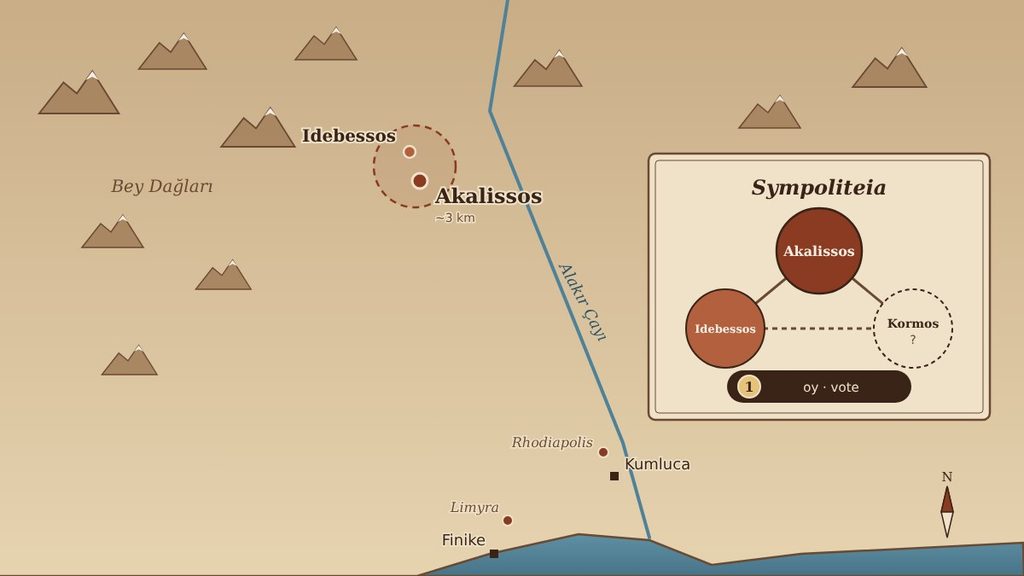
The remains of Akalissos lie north of Kumluca, near the road leading to the Alakır valley, about 3 km south-south-east of its neighbour Idebessos. The area today is wooded and rugged, and the old routes between the ancient cities were largely shaped by this mountainous terrain.
A Union of Three Cities: Akalissos, Idebessos and Kormos
In the city unions the Greeks called sympoliteia, small cities came together under a shared citizenship and government. Inscriptions found at Idebessos show that Akalissos, Idebessos and Kormos formed such a union, led by Akalissos.
In the Roman period this union was represented in the Lycian League by a single shared vote. Cities in the League held one, two or three votes according to their size, and unions like this allowed cities too small for a vote of their own to have a say in the federal government. Researchers believe the union aimed both at representation in the League and at economic strength and security. For more on Lycia’s system of proportional representation, see our Lycian League article.
Akalissos in Ancient Sources and on Coins
The city’s name appears in ancient sources in several spellings: Akalissos, Akalessos, Akalisos. It is mentioned in the geographical dictionary of Stephanus of Byzantium and in the 6th-century list of Eastern Roman cities compiled by Hierocles. A tomb inscription found at the site also preserves the name Akalissos.
Akalissos is known to have minted coins in its own name. Examples are held in several collections, notably the British Museum’s catalogue of Lycian coins. Minting coins was an important sign that a city had its own government and economic strength.
A Bishopric in the Eastern Roman (Byzantine) Period
Akalissos remained inhabited in the Eastern Roman (Byzantine) period and became a bishopric. Church records of the 7th and 9th centuries list Akalissos among the bishoprics under Myra, the religious centre of Lycia. It does not appear in later records, which suggests the city lost its importance in the Middle Ages. Today the Catholic Church lists Akalissos as a titular see.
The Remains
The remains of Akalissos were first described in 1842 by the British explorers Thomas Spratt and Edward Forbes, who travelled through the region. Even then they were in poor condition.
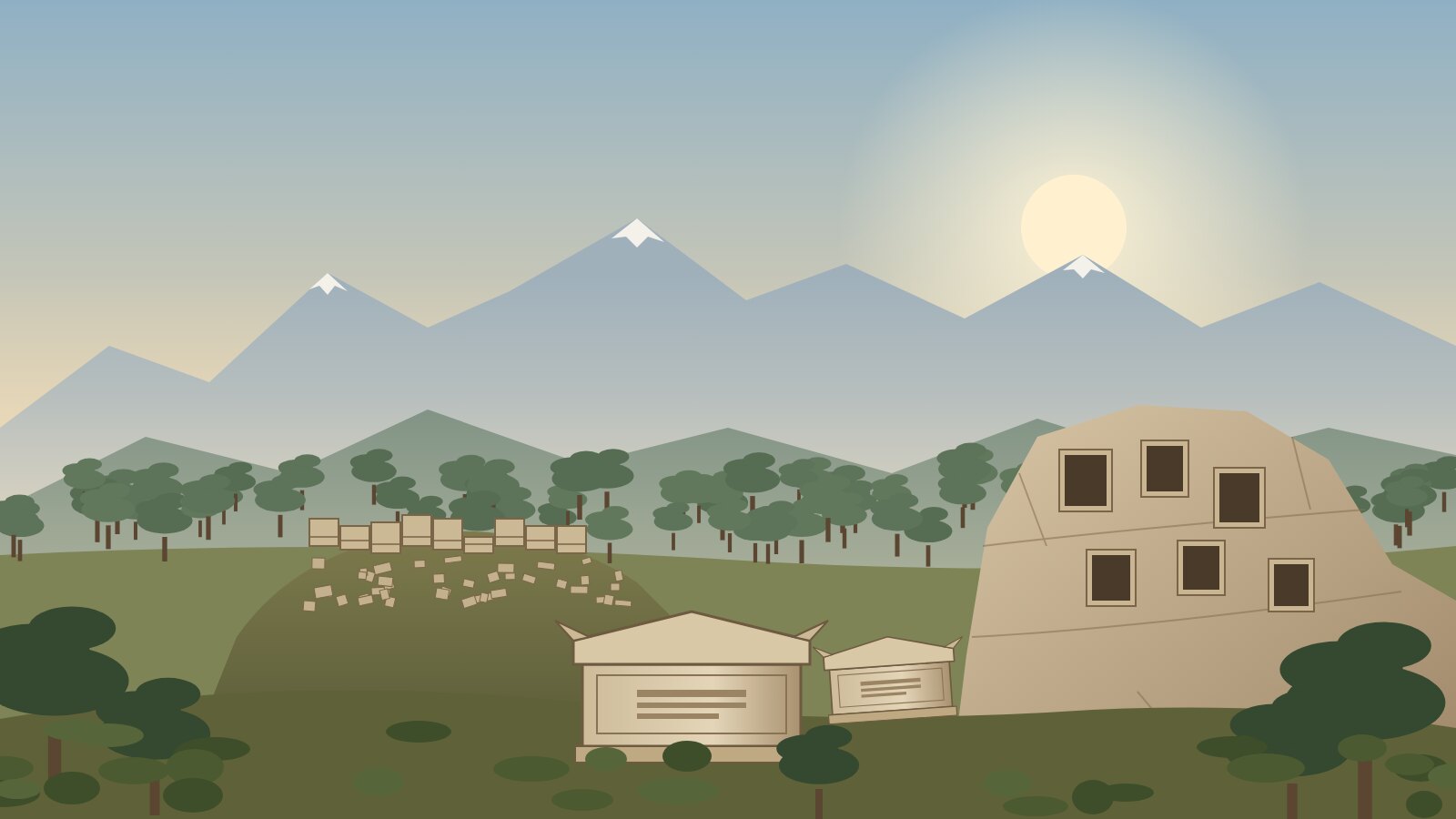
Today no building at the site can be securely identified by its function. The best-preserved remains are tombs: a few inscribed Roman sarcophagi and several simple rock-cut tombs. The rock-cut tombs are not of the house-shaped type distinctive to Lycia. The hill regarded as the acropolis, and the structures on it, have suffered serious damage and looting. Most of the visible remains date from the Roman and Eastern Roman (Byzantine) periods. Researchers note that scientific excavation could reveal finds from earlier periods.
Akalissos shows how vulnerable small, unexcavated ancient cities are. Please do not damage the remains or move any fragment, and if you see signs of illegal digging, report them to the gendarmerie or the museum directorate. See our Sustainable Travel and Ethics Guide for details.
Visiting Information
Akalissos has not been excavated. There is no entrance, ticket office or signage at the site, and the terrain is wooded and rugged. Visitors are advised to go with a local guide or someone who knows the area. Carry enough water and wear sturdy footwear.
You can visit Akalissos on the same day as its neighbour Idebessos. Rhodiapolis and Korydalla, both near Kumluca, can be added to the same trip.
❓ Frequently Asked Questions
Where is Akalissos?
North of Kumluca in Antalya province, about 3 km south-south-east of Idebessos.
What makes Akalissos significant?
It led the union of cities formed with its neighbours Idebessos and Kormos, minted its own coins and was a bishopric in the Eastern Roman (Byzantine) period.
Is there an entrance fee for Akalissos?
No. As an unexcavated site, it is free to enter, but there are no visitor facilities.
Sources
- Nevzat Çevik, Lykia Kitabı: Arkeolojisi, Tarihi ve Kültürüyle Batı Antalya, Türk Tarih Kurumu, Ankara 2021.
- Tarkan Tan, Idebessos, Akalissos ve Kormos: Kent Tarihi, MA thesis, Marmara University, 2019.
- T. A. B. Spratt – E. Forbes, Travels in Lycia, Milyas, and the Cibyratis, London 1847.
- G. F. Hill, Catalogue of the Greek Coins of Lycia, Pamphylia, and Pisidia, British Museum, London 1897.
- Lycian Monuments: Akalissos