
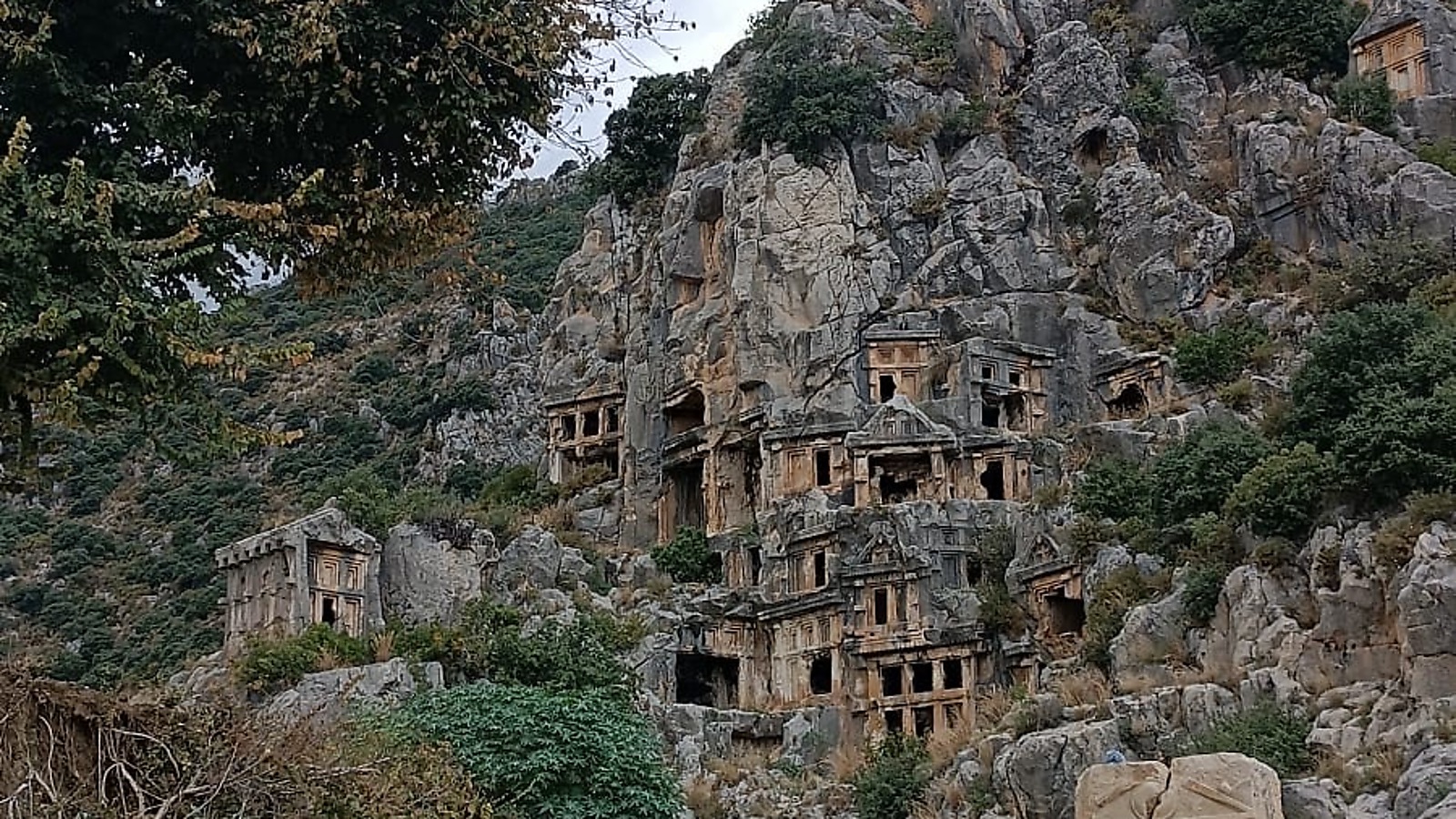

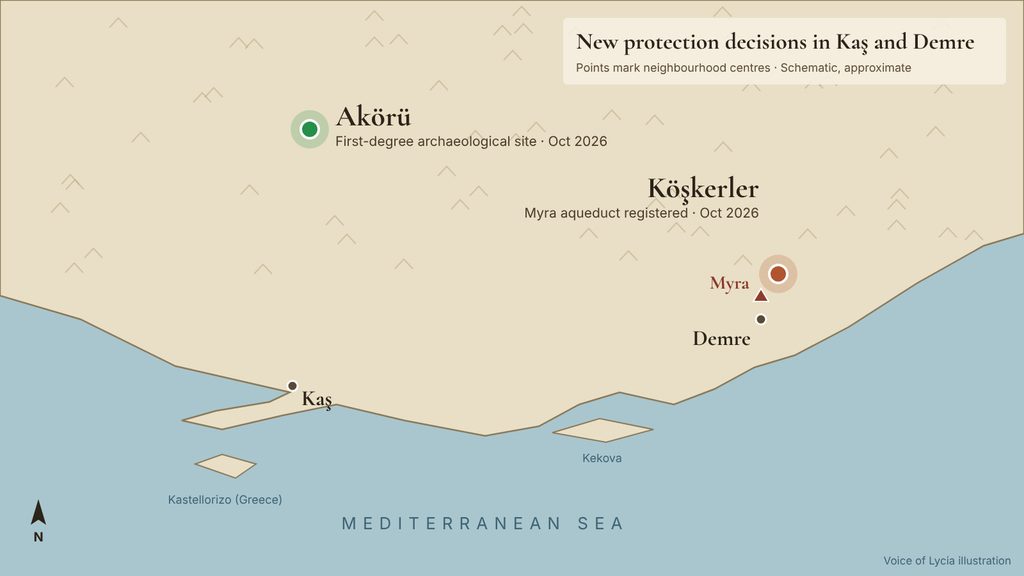
Three protection decisions taken in recent months in Kaş and Demre show how many ancient remains in the region are still unrecorded, and how they come to light. At its meeting on 9 October 2026, the Antalya Regional Board for the Protection of Cultural Property declared an ancient settlement found in the Akörü neighbourhood of Kaş a first-degree archaeological site, and registered part of the aqueduct of the ancient city of Myra in Demre. On 1 November 2026, the Official Gazette published a general registration decision covering newly identified ancient settlement areas in both districts.
Kaş, Akörü: An Ancient Settlement Revealed by a Complaint
The Akörü site came to attention through a citizen’s complaint. According to the board’s decision, a complaint filed through the CİMER public complaints system on 27 April 2026 reported that archaeological remains on Treasury land in the neighbourhood were being destroyed by heavy machinery. On-site inspections identified an ancient settlement on two parcels, partly privately owned and partly Treasury land.
The decision records a church, boundary or defensive walls, and complexes of adjoining buildings at the site. The board registered the area as a first-degree archaeological site. Under this status, no excavation other than scientific excavation is permitted, and no new construction, new farmland, or removal of stone and soil is allowed.
The final part of the decision is striking. Noting that a criminal complaint had already been filed over the unauthorised work, but that complaints of continuing work were still being received, the board reminded the municipality and law enforcement that “no construction or physical intervention whatsoever” may take place at the site, and that legal action would otherwise follow. The decision does not say who carried out the damage.
According to Antalya Ekspres, three ancient settlement areas in Akörü had already been registered as first-degree archaeological sites in 2021. The neighbourhood lies near the Lycian city of Kandyba, although the new decision does not link the site to Kandyba.
Demre, Köşkerler: Myra’s Aqueduct Beside a Quarry
The second of the Kaş and Demre decisions came about during a quarry application. According to the board’s decision, remains of an ancient water channel were identified while reviewing a request for opinion on a planned capacity increase and the addition of a crushing and screening plant at a stone quarry in the Köşkerler neighbourhood.
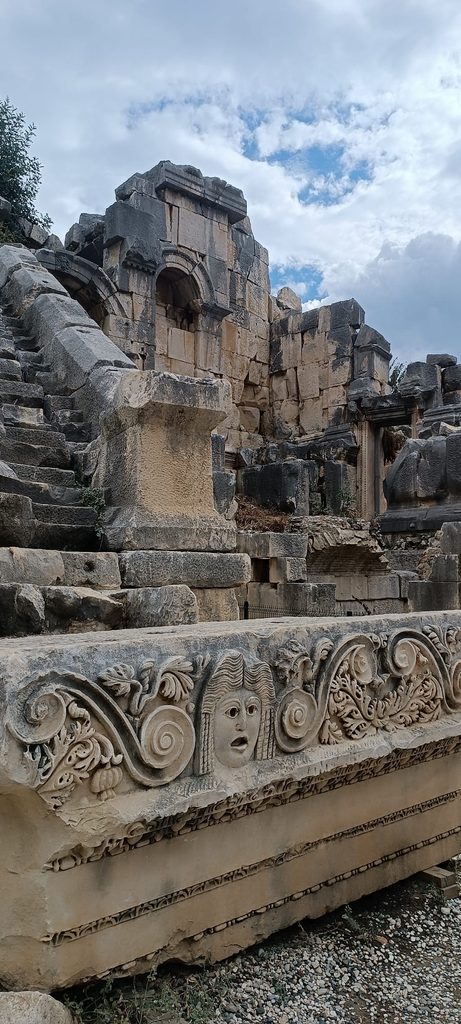
The remains belong to the aqueduct built to supply the ancient city of Myra. On the western slope of the Demre Valley, the channel is, as the decision describes, partly cut into the bedrock and partly set on retaining terraces. The route of Myra’s aqueduct was registered in 2002; this section was documented separately after the Museum Directorate cleared the vegetation.
The board registered the remains as a Group I immovable cultural property and ruled that no work may take place within the protection zone without its permission. The institutional opinions cited in the decision include one from the General Directorate of Mining and Petroleum Affairs asking that “existing licence areas be taken into account”. The decision does not state the outcome of the quarry application.
A General Registration for Kaş and Demre in the Official Gazette
The Official Gazette of 1 November 2026 (issue 33417) published a separate decision taken by the board on 22 June 2026. Under it, ancient settlement areas and cultural property identified during surveys around registered sites and protection zones in Kaş and Demre were registered under Law No. 2863 on the Protection of Cultural and Natural Property.
The notice includes a map of the area from Kaş to Demre and coordinate tables, but the text does not list the names, neighbourhoods or parcels of the registered areas. This new registration in Kaş and Demre does not concern well-known ancient cities such as Myra, Antiphellos or Patara, which were already protected, but newly identified areas around them.
Voice of Lycia Note
Both decisions in Kaş and Demre show that ancient remains are often recorded only after damage or an investment application. Beyond the well-known cities, the Lycian countryside holds many settlements, roads and water structures that have yet to be documented. For more on Myra, see our Myra Ancient City page; for Lycian water engineering, see our Ancient Water Structures of Lycia article.
We are sending our questions about the list of areas registered in Kaş and Demre and the implementation of the decisions to the relevant institutions, and will report their answers separately.
Sources
- Antalya Regional Board for the Protection of Cultural Property, decision no. 22883, 9 October 2026 (Kaş, Akörü).
- Antalya Regional Board for the Protection of Cultural Property, decision no. 22878, 9 October 2026 (Demre, Köşkerler).
- Antalya Regional Board for the Protection of Cultural Property, decision no. 22144, 22 June 2026; Official Gazette, 1 November 2026, issue 33417 (in Turkish).
- Antalya Ekspres – First-degree archaeological site decision in Kaş (16.10.2026, in Turkish)
Voice of Lycia news is prepared in line with our Editorial Principles. If you notice an error, please let us know.