

The Lycian League: A Model Federation of the Ancient World
📌 Contents
- How Did the Lycian League Work?
- The Voting System: Representation by Size
- The Council House at Patara
- Montesquieu’s Praise
- Its Echo in the US Constitution Debates
- The Lycian League in the Roman Period
- The Spirit of Independence and the Landscape
- Tips for Travellers
- Frequently Asked Questions
- Sources
The Lycian League was one of the most remarkable federal structures of the ancient world. The cities of Lycia kept their independence in local affairs while acting as one in common matters, voting in their shared assembly according to their size. Centuries later, Montesquieu praised the League as a model federal republic, and this praise was echoed in the debates over the US Constitution.
The League’s exact founding date is unknown, but inscriptions show that it existed by the early 2nd century BC. Its roots lie in the older tradition of Lycian cities acting together. What made the League special was its system of proportional representation, in which cities were represented according to their size. This is one of the clearest known examples of the principle in the ancient world.
🏛️ 1. How Did the Lycian League Work?
The most detailed description of the Lycian League comes from the geographer Strabo, writing in the early 1st century AD. According to him:
- The League included 23 cities.
- Representatives of the cities met in a common assembly (synedrion), held each time in a chosen city.
- At the head of the League was the Lyciarch, elected every year. The League’s other officials and judges were also chosen in proportion to the size of the cities.
- The cities were independent in their local affairs, while common matters such as war, peace and alliances were decided by the League.
🏛️ 2. The Voting System: Representation by Size
According to Strabo, the cities of the Lycian League were divided into three groups by size, and they contributed to common expenses in proportion to their voting power.
| City group | Votes | Which cities? |
|---|---|---|
| Largest cities | 3 votes | Xanthos, Patara, Pinara, Olympos, Myra, Tlos |
| Middle-sized cities | 2 votes | Not individually named in ancient sources |
| Small cities | 1 vote | Not individually named in ancient sources |
This system struck a balance between the weight of the large cities and the voice of the small ones.
🏛️ 3. The Council House at Patara
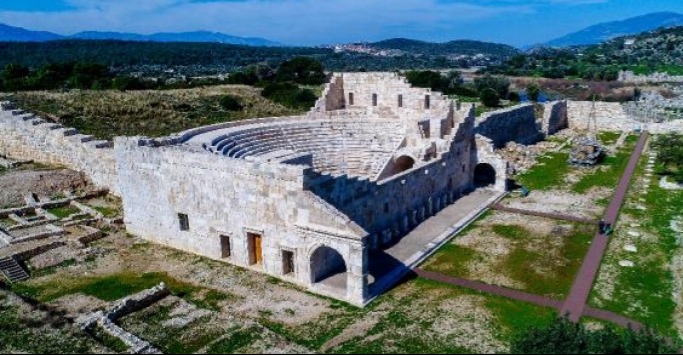
The council house (bouleuterion) at Patara is identified by the excavation team as the meeting place of the Lycian League’s assembly.
- Architecture: A roofed meeting hall resembling a theatre, with its seats arranged in a semicircle.
- Restoration: It was brought back to life through extensive restoration carried out by the excavation team with the support of the Ministry of Culture and Tourism, and opened to visitors. Today it is one of Patara’s most impressive buildings.
🏛️ 4. Montesquieu’s Praise
The French thinker Montesquieu, discussing federal republics in The Spirit of the Laws (1748), held up the Lycian League as an example:
“Were I to give a model of an excellent confederate republic, I should pick upon that of Lycia.”
What impressed Montesquieu was the League’s practice of giving cities votes according to their size, which he saw as one of the best ways of creating a fair balance among member cities.
🏛️ 5. Its Echo in the US Constitution Debates
The founders of the United States studied ancient federations while debating the structure of the new state.
- James Madison included the Lycian League in the notes on ancient and modern confederacies he made in 1786.
- Alexander Hamilton quoted Montesquieu’s praise of Lycia, and described its voting system, in No. 9 of The Federalist (1787).
When the question of how to represent large and small states was debated, the Lycian League was among the historical examples cited. Although the final form of the US Constitution was the result of many different debates and compromises, the appearance of Lycia in these discussions shows the League’s place in modern political thought.
🏛️ 6. The Lycian League in the Roman Period
- 167 BC: Lycia was for a time under the control of Rhodes. In 167 BC Rome ended this control and recognised Lycia’s freedom, and the League grew stronger.
- AD 43: Under the Emperor Claudius, Lycia became a Roman province.
- The League continues: The Lycian League survived in the provincial period, taking on mainly shared religious ceremonies, the imperial cult and some administrative tasks.
🏛️ 7. The Spirit of Independence and the Landscape
Lycia’s rugged mountains separated its cities and helped each preserve its own local identity. The same harsh landscape also led the cities to act together against outside threats. The Lycian League was the product of this balance between local independence and shared solidarity. For the region’s natural world, see our Lycian Nature page.
Tips for Travellers
- The council house at Patara: Sit on its benches and imagine the League’s representatives debating here. Also visit the nearby theatre and main street.
- The Patara Road Monument: Found at Patara, this monument lists the roads and distances between Lycian cities, an important record of Lycia’s organisation in the Roman period.
- Museum visit: You can see coins of the Lycian League in the coin collection of the Antalya Museum. Many League coins show the head of Apollo and a lyre.
The Light of Freedom
The Lycian League is a lesson in government that reaches us from among the stones. It shows that cities of different sizes could live together in a fair balance. Understanding this political memory of the Land of Light means seeing some of the roots of the ideas of government we hold today. For more of Lycia’s heritage, explore our Lycian Memory section.
🏛️ Frequently Asked Questions (FAQ)
When was the Lycian League founded?
Its exact founding date is unknown. Inscriptions show that the League existed by the early 2nd century BC, and it grew stronger after Rome ended Rhodian control over Lycia in 167 BC.
How many cities were in the Lycian League?
According to Strabo, 23. The six largest (Xanthos, Patara, Pinara, Olympos, Myra and Tlos) had three votes each.
How was the head of the League chosen?
The head of the League, the Lyciarch, was elected every year by the League’s common assembly.
What was the place of women in Lycia?
Herodotus writes that the Lycians named themselves after their mothers. However, in Lycian and Greek inscriptions people are mostly named after their fathers, so this was not a general rule. Some inscriptions name women as owners of tombs and property, but only male citizens held office in the League’s political institutions.
Sources
- Strabo, Geography, Book XIV, Chapter 3
- Montesquieu, The Spirit of the Laws (1748), Book IX, Chapter 3
- James Madison, Notes on Ancient and Modern Confederacies (1786)
- Alexander Hamilton, The Federalist, No. 9 (1787)
- Ralf Behrwald, Der lykische Bund (2000)
- Trevor R. Bryce, The Lycians in Literary and Epigraphic Sources (1986)
- UNESCO World Heritage: Xanthos-Letoon