

Found Here and Nowhere Else
The Endemic and Rare Species of Lycia are living things found only in this region, or in very few places on Earth. A species is endemic when it lives naturally in only one part of the world, and Lycia is exceptionally rich in them. Some salamanders, orchids and mountain plants are found only on a few slopes of this region, or even in a single valley. If they disappear here, they will never be seen anywhere else again.
In this article you will meet Lycia’s best-known endemic and rare species, learn why the region is so rich in them, what threatens them and what we can do to protect them.
📌 Contents
Endemic and Rare Species of Lycia: Why So Many?
There are three main reasons for Lycia’s wealth of endemic species:
- Altitude: Within a short distance, the land rises from the sea to summits above 3,000 metres, bringing very different habitats together.
- Isolated mountains and valleys: The summits and deep valleys of the limestone mountains are like separate “islands”. Over thousands of years, life evolved separately on each of them and gradually became distinct species.
- Limestone: Cracks and caves in the limestone provide shelter for moisture-loving creatures such as salamanders.
Lycian Salamanders
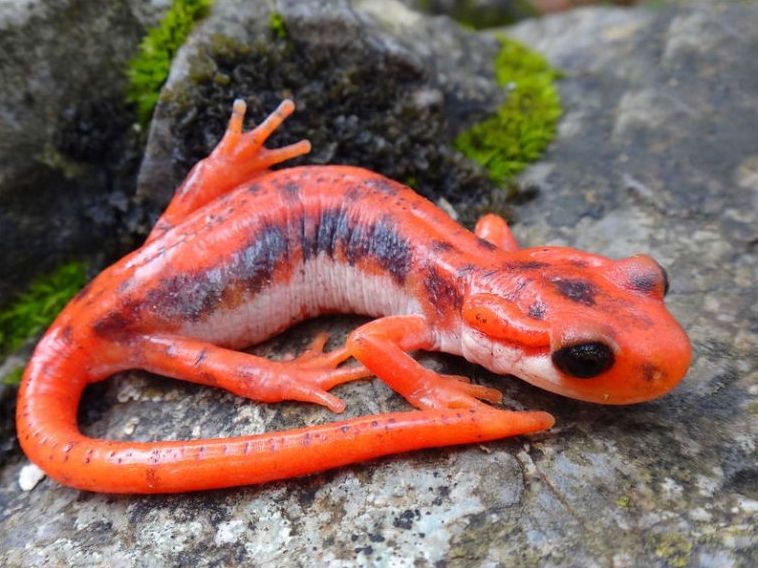
The species of the salamander genus Lyciasalamandra live almost exclusively in the limestone mountains of Lycia, and the genus takes its name from the region.
- Way of life: They spend the dry summer in rock crevices and underground, emerging on rainy days in the damp winter months.
- Live birth: Unlike most salamanders, they do not lay eggs but give birth to live young, which allows them to breed on land without water.
- Tiny ranges: Each species or subspecies lives in its own very small area. For some, the entire range on Earth is only 4–40 square kilometres.
Different species live in different parts of Lycia:
- Between Dalaman and Fethiye: Lyciasalamandra fazilae, listed as Endangered by the IUCN.
- Around Kaş and Finike: Between Patara and Demre: Lyciasalamandra luschani, also found on the island of Kastellorizo (Meis) offshore.
- The coastal mountains between Kemer and Tekirova: Lyciasalamandra billae, several of whose subspecies are critically endangered.
- Around Antalya: Lyciasalamandra antalyana.
For more, see our Lycian Salamander.
The Kaş Orchid and Antalya’s Endemic Orchids
Dozens of orchid species grow in Lycia. Some are known only from this region, and their survival is under serious threat.
- The Kaş orchid (Ophrys lycia): Known only from the area around Kaş. Its flower mimics the shape of certain insects to attract pollinators. Some botanists classify it as a subspecies of Ophrys sphegodes.
- Ophrys climacis and Ophrys phaseliana: Two more endangered orchids endemic to Antalya. Phaseliana takes its name from the ancient city of Phaselis.
- The Kemer orchid: Described in the press as an orchid “found only in Kemer”. The fine for picking it exceeds half a million lira.
The known populations of these orchids are few and small. The loss of a few dozen plants on one slope can mean the disappearance of a species from the world. For more, see our Kaş Orchid article.
Endemic Plants of the Bey Mountains
More than 865 plant species have been recorded in Beydağları Coastal National Park, some of them endemic. Of the 177 species recorded around Phaselis alone, 22 are reported to be endemic.
- Lycian ironwort (Sideritis lycia): A mountain tea species unique to these mountains.
- Stachys sericantha: A vulnerable species found only in the national park.
Many more endemic plants grow higher up, among the rocks above the tree line. For these vegetation zones, see our Lycian Flora page.
A Rare Neighbour: The Cretan Date Palm
The Cretan date palm (Phoenix theophrasti) is Türkiye’s only native palm. It is not unique to Lycia: it grows in a few small stands in the eastern Mediterranean, on Crete and along Türkiye’s southwest coast. One of these rare stands in Türkiye is near Kumluca, in eastern Lycia.
Threats
- Habitat loss: Building on the coast and foothills, along with road and resort construction, can directly destroy the habitat of species confined to a few square kilometres.
- Collecting: Orchid tubers are dug up to make salep. Tubers of some species have even been reported for sale online abroad.
- Forest fires: Large fires can be devastating for species with tiny ranges.
- Climate change: Longer, hotter summers put pressure on moisture-dependent salamanders and mountain plants.
How Can We Protect Them?
Protecting the Endemic and Rare Species of Lycia starts with small choices made by every visitor:
- Do not pick or collect: Do not pick orchids or wild plants, or dig up their bulbs. Do not take salamanders from the wild.
- Do not share locations: Never share the locations of rare species on social media. In this article, too, we give no exact locations.
- Do not buy salep: Avoid salep of unknown origin.
- Report it: Report anyone collecting plants or damaging habitats to the gendarmerie.
- Support conservation: Support conservation work and research in the region.
For all our principles, see our Sustainable Travel and Ethics Guide.
❓ Frequently Asked Questions
What does endemic mean?
It means a species lives naturally in only one region of the world. A species endemic to Lycia is found nowhere else in the wild.
Where can I see Lycian salamanders?
They can be seen among limestone rocks on damp winter days, but to protect them we do not share where they live. If you see a salamander, do not touch it and do not share its location.
Is there a fine for picking orchids?
Yes. Fines for collecting orchids and endemic plants without permission are very high, exceeding half a million lira for some species.