
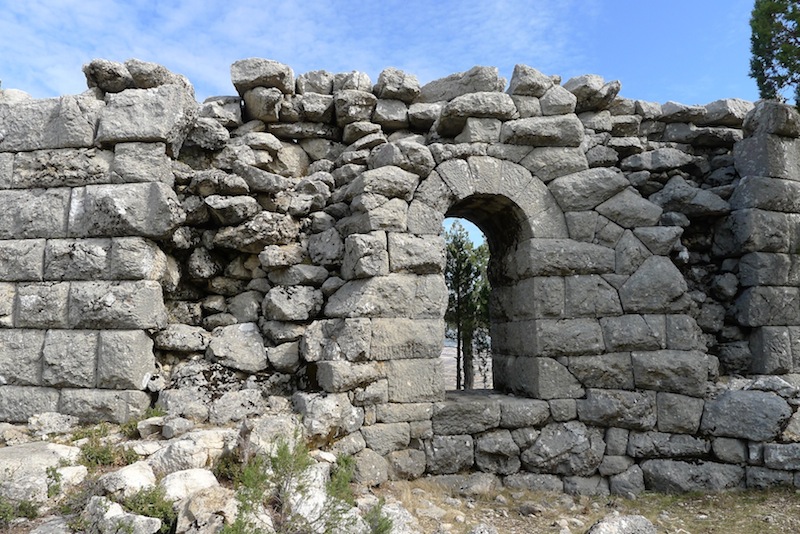

Oinoanda Ancient City: The Ancient City of Philosophy and Wine
Welcoming you at the end of a narrow and steep 45-minute path right above the İncealiler Village in the Fethiye district of Muğla, Oinoanda Ancient City is one of the most rewarding stops in Lycia for a true exploration enthusiast. Its isolated position from the modern world has enabled the city to preserve its mystical atmosphere.
Oinoanda first appears as a settlement name in Hittite texts from the 13th century B.C. as “Wiana”. This root, meaning “wine” in the Luwian language, transitioned into Greek as “Oine” (vine stock) and “Oinos” (wine). The name of the city stands as the most concrete token of the viticulture and wine culture that has persisted on these lands for thousands of years.
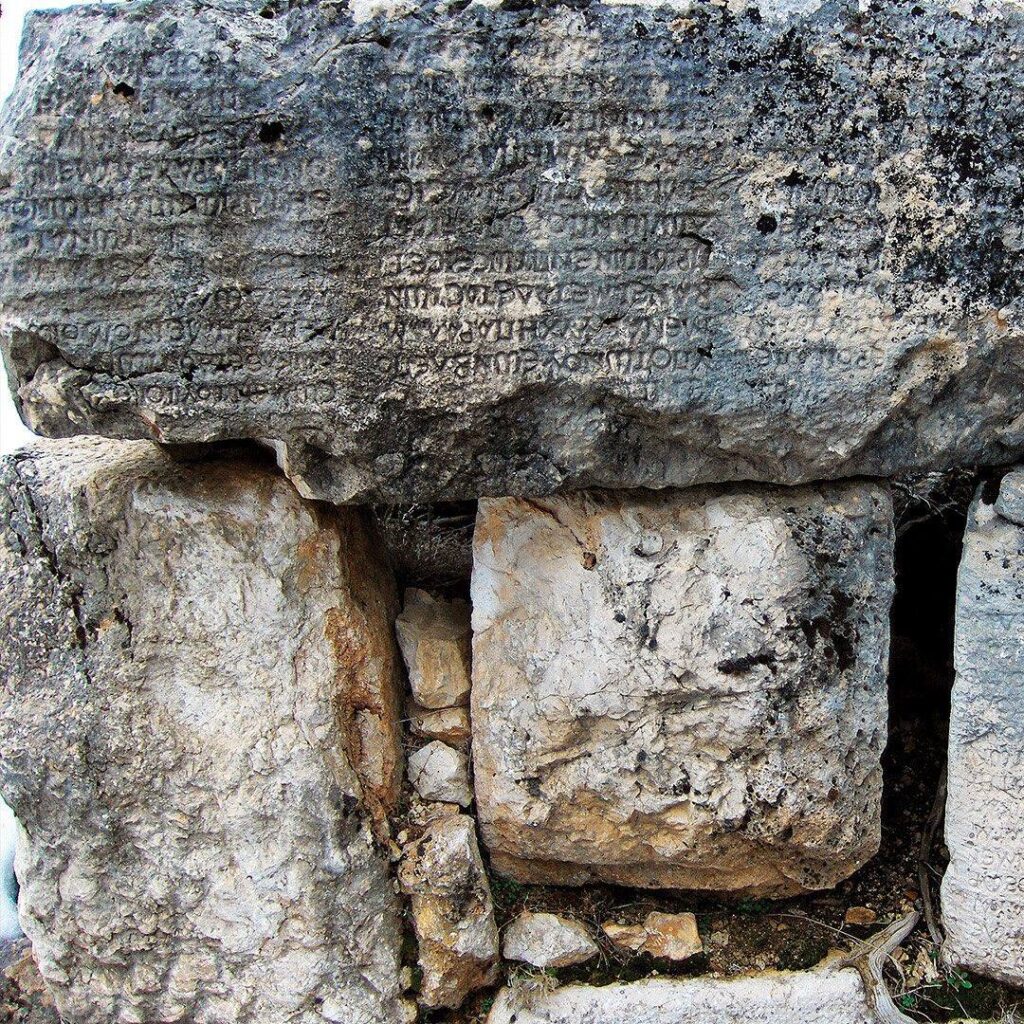
The Legacy of Diogenes: The Largest Philosophical Inscription in the World
The primary element that makes Oinoanda globally unique is the Epicurean philosopher Diogenes, who lived here in the 2nd century A.S. (A.D.). In his old age, Diogenes spent his entire fortune to have a massive inscription carved onto the walls of the city’s northern stoa (colonnaded gallery).
Why Was Philosophy Written on a Wall?
Diogenes believed that people were unhappy due to fear and empty desires. These texts, carved onto the approximately 80-meter-long wall of the stoa, contained Epicurean teachings on topics such as physics, ethics, and old age. The goal of Diogenes was to ensure that anyone coming to the market or visiting the city could read these writings and attain spiritual tranquility (Ataraxia).
Although the structure is ruined today, it is possible to see fragments belonging to this philosophical inscription in every corner of the city. Erected with the purpose of “helping humanity,” these stones continue to be assembled like a puzzle by archaeologists today. You can examine our Lycian History page for more information regarding this intellectual depth of the city.
Political Power: The Tetrapolis and the Lycian League
Due to its strategic positioning, Oinoanda took part in powerful alliances throughout history. Along with Kibyra, Boubon, and Balboura, the city was a member of the famous Tetrapolis (League of Four Cities) during the 2nd and 1st centuries B.C. Within this league, Oinoanda held a balance-defining role as a military and commercial powerhouse.
When the Tetrapolis was dissolved in 82 B.C. by the Roman General Murena, Oinoanda was officially incorporated into the territories of the Lycian League. This participation allowed the city to witness extensive construction activities during the Roman Imperial period.
Architectural Masterpieces: Fortifications, Temples, and Baths
The earliest ruins visible in Oinoanda today are the massive fortification walls dating back to the 200s B.C. However, the true grandeur of the city is hidden within the public buildings constructed during the Roman period:
- The Temple of Augustus: Built at a point commanding the upper agora, this temple in the Doric order was dedicated to Emperor Augustus. Inscriptions written in honor of the emperor have been unearthed inside it.
- The Grand Gymnasium and Bathhouse Complex: Constructed on the west side of the city in the 140s A.S. (A.D.). The donations of Opramoas of Rhodiapolis, the most famous philanthropist of Lycia, were utilized in the financing of this structure. The building was later expanded with a colonnaded courtyard dedicated to Emperors Septimius Severus and Caracalla.
- Aqueducts: Constructed during the Flavian period, the aqueducts stand as proof of how advanced the city was in water engineering despite its high altitude.
The Family Tree Monument: The Heroon of Licinnia Flavilla
The necropolis (cemetery) area of the city is surrounded by grand tombs stretching along the slopes. Among these, the most remarkable is the Heroon of Licinnia Flavilla, dating to the 2nd century A.S. (A.D.).
This monumental tomb is not just a sepulcher but also a massive family tree. The inscriptions upon it provide the genealogy of Licinnia Flavilla’s family spanning multiple generations. This stands as a priceless document in terms of demonstrating how sacred nobility and family ties were considered in antiquity.
The Origin of Oinoanda: Eceler Höyük
The history of Oinoanda actually dates back much further than the hill upon which the city was established. Situated east of the city, north of the Seki Town, Eceler Höyük (Eceler Mound) is accepted as the prehistoric ancestor of the city. Surface finds indicate that life here continued uninterrupted from the Chalcolithic Period down to the Roman Era. It is estimated that the people of Oinoanda relocated from this mound in the plain up to the steep hill above due to security concerns.
You can examine our Lycian Flora guide for rare species growing in this rugged geography of the region, and our Lycian Fauna guide for the wildlife.
Oinoanda Ancient City Essential Information Table
| Feature | Detail |
| Location | Muğla / Fethiye / İncealiler |
| Altitude | Approximately 1,450 Meters |
| Most Important Monument | The Philosophical Inscription of Diogenes |
| Political Alliance | Kibyratis Tetrapolis |
| Etymology | “Wiana” (Wine / Vineyard) |
| UNESCO Status | Under Research and Protection Process |
🏛️ The Voice Inside the Silence
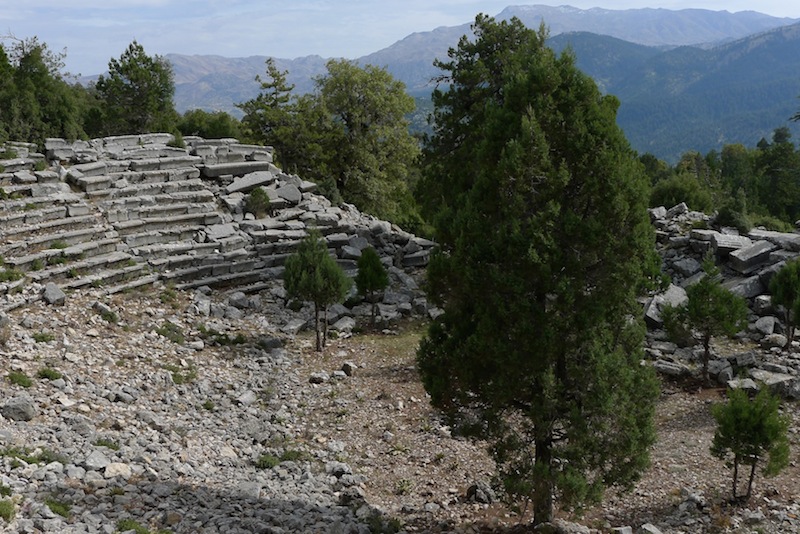
The Oinoanda Ancient City offers you a genuine antiquity experience thanks to remaining secluded from mass tourism. When you climb the path and stand in the middle of the agora, you almost hear the following words of Diogenes amidst the howling of the wind: “Happiness is the body being free of pain and the soul being free of disturbance.” Do not forget to photograph the unique cedar forests of the city and the mountain scenery against which the city leans during your trip. You can follow the website of the T.R. Ministry of Culture and Tourism for current travel notes for 2026.
🏛️ Frequently Asked Questions (FAQ)
How do I get to Oinoanda Ancient City?
You need to reach Seki Town from the Fethiye district of Muğla, and proceed to İncealiler Village from there. After reaching the village, the ancient city is arrived at via a 45-minute path walk that can be challenging in places. Professional hiking shoes are a must.
Why is the Diogenes Inscription so important?
Because it is the longest and most comprehensive philosophical text known to have been carved into the center of a city in the ancient world, with the aim of teaching happiness to ordinary people.
What is the best time to visit Oinoanda Ancient City?
Since the city is located at a high altitude (approx. 1,450 m), it is snowy in winter and cool in summer. The most ideal visiting times are May–June or September–October.
Is there an admission fee?
Currently, there is no ticket booth at the entrance of the archaeological site, and admission is free. However, due to the challenging road and secluded nature of the city, it is recommended to go with a guide or a group of friends.