
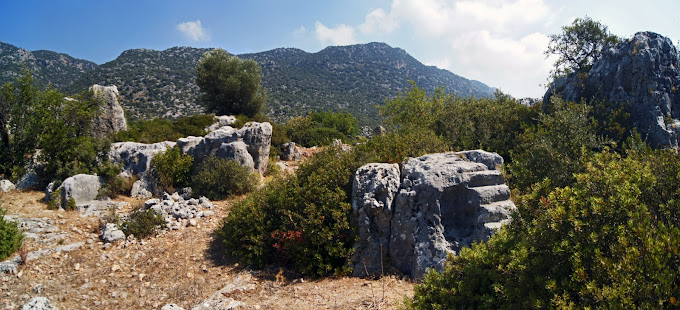

The Eye of the Mountain Overlooking Teimiussa
Located near the Çevreli town in the Demre district of Antalya, Tyberissos Ancient City stands as one of the most important inland fortress settlements securing the coastal safety of Lycia. Established atop a steep hill at an altitude of approximately 280 meters, just two kilometers north of the Teimiussa harbor, this ancient settlement proves with its heavily fortified walls just how secure a stronghold it was in its era.
Accessed today only by a narrow trail from Çevreli, Tyberissos has successfully remained far from mass tourism, preserving its ancient fabric in its absolute purest state.
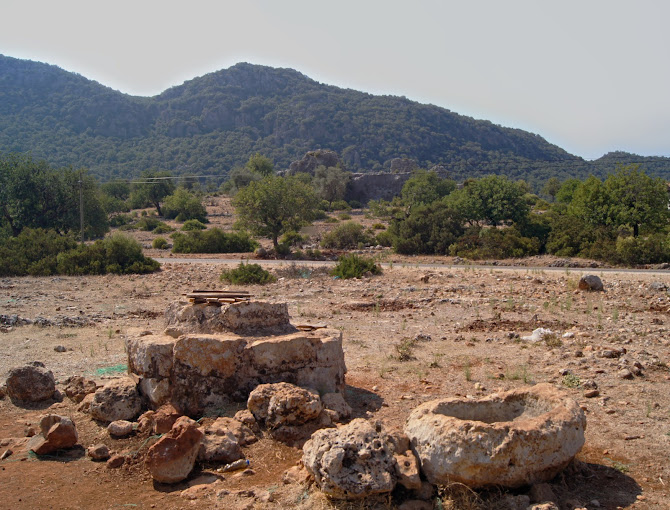
🏛️ From “Tubure” to Tyberissos: Historical Roots
The name of Tyberissos echoes on the stage of history for the first time in the 5th century B.C. On the famous Inscribed Pillar located in the Lycian capital of Xanthos (Arñna), the name of the city is recorded as “Tubure”. This record demonstrates that long before Hellenization, the city was already an active actor within the Lycian League, possessing an authentic Lycian identity.
Architectural Evolution and the Dual Temple Cult
Architecturally, Tyberissos stands as a unique example showing how indigenous Lycian and Hellenistic cultures beautifully merged.
1. From Simple Dwellings to Sophisticated Urbanism
In the 5th century B.C., the city was a fortress settlement consisting of simple, single-room houses built on terraces enclosed by defensive walls. However, by the 2nd century B.C., Tyberissos underwent a massive transformation:
- The Formation of the Agora: The agora, acting as the social and commercial heart of the city, was constructed.
- Evolution of Domestic Living: The number of rooms within the dwellings increased, and finely dressed masonry blocks decorated with reliefs began to be used on the walls. This serves as the greatest proof of the city’s rising economic prosperity.
2. Two Distinct Temples: Lycian and Hellenistic
Standing side-by-side in the sacred enclosure (temenos) situated in the southern part of the settlement, two distinct temples draw immediate attention:
- The Lycian Temple: Likely constructed originally of timber, this traditional Lycian temple reflects the deep-rooted nature of native religious beliefs.
- The Temple of Apollo: Constructed in the Doric order during the Hellenistic period, this stone temple was dedicated to the god Apollo. As a highly interesting detail, this temple also faces south, complying with local Lycian architectural traditions.
🏛️ Three Fundamental Features to Know About Tyberissos
| Feature | Detail |
| Historical Name | The ancient “Tubure” documented in the monumental Xanthos inscriptions. |
| Political Status | Member of a three-city Sympoliteia established alongside Myra and Teimiussa. |
| Religious Hub | Hosts a Hellenistic temple of Apollo constructed in the Doric order. |
Diplomatic Power: Rome and the Sympolity
During the Roman Empire period, Tyberissos Ancient City maintained its presence as part of a Sympoliteia (political alliance) alongside the regional metropolis Myra and the neighboring harbor town Teimiussa. This alliance allowed smaller settlements to protect their sovereign rights against giants and pursue a unified foreign policy.
An inscription found in the city dedicated to Emperor Augustus documents that even during the golden age of Rome, Tyberissos maintained exceptionally strong diplomatic ties with the central authority. Furthermore, honorific statue bases dedicated to citizens celebrated for their generosity demonstrate the local population’s deep devotion to their city.
Geography and Nature: Vegetation at the Summit of the Mediterranean
Thanks to its rugged and steep terrain, Tyberissos shelters some of the most pristine examples of the Lycian Flora. Wild strawberry trees (Arbutus arborescens), bay laurels, and wild olive groves accompanying you along the narrow trail perfectly complete the ancient atmosphere of the city. Furthermore, due to its high-altitude setting, the local wildlife and bird species present an exciting diversity for observers of the Lycian Fauna.
2026 Travel Notes and Recommendations
- The Trail Hike: The climb up the hill can be quite challenging, but the sweeping panoramic view of Teimiussa and Kekova waiting at the summit will instantly make all your physical exhaustion worth it.
- Inscription Hunting: Try to locate the monumental inscription of Augustus and the carvings on the exterior walls of the Temple of Apollo; get a close look at how history was permanently etched onto stone.
- Breathe in the Silence: Tyberissos is one of the least-visited ancient sites in Lycia. Dedicate some quiet time here to simply listen to the sounds of nature and history.
🏛️ Loyalty Behind the Mountains
The Tyberissos Ancient City serves as a powerful reminder that great empires did not leave their traces only on the shorelines, but also in the steepest corners of the mountains. This historical journey extending from “Tubure” to Augustus stands as a silent monument to how passionately the Lycian people clung to their independence and local traditions. Do not forget to follow the website of the T.R. Ministry of Culture and Tourism to keep up with current research news and preservation projects for 2026.
🏛️ Frequently Asked Questions (FAQ)
How do I get to Tyberissos Ancient City?
After reaching the Çevreli town from Demre, you can ascend to the hilltop via an approximately 45-minute hike along a narrow, marked trail. Wearing professional hiking shoes is absolutely essential.
Is there an admission fee and is the Museum Pass (Müzekart) valid?
Tyberissos currently does not have an official ticket booth or enclosure. Admission is entirely free; however, because there are no facilities of any kind on the hill, you must carry your own water and food supplies.
What does the site look like from aerial photography?
The terraced planning of the city and the clear lines of its fortification walls can still be easily distinguished from above, proving that Tyberissos possessed a highly organized, systematic urban layout.